You take the case, we manage the rest.
Give the patient your whole attention. We'll run the rest — the record, the last remedy and potency, the follow-up that proves whether it worked, the appointments, the reminders, your clinic's own website. All of it, in one place, on or off the network.

I practise
Run the clinic: patients, case notes, repertorisation, prescriptions, signed PDFs, reminders and a patient app that answers back.
I'm studying
The same materia medica, repertories and philosophy corpus a practising doctor reads — searchable in English and Devanagari. No clinic attached.
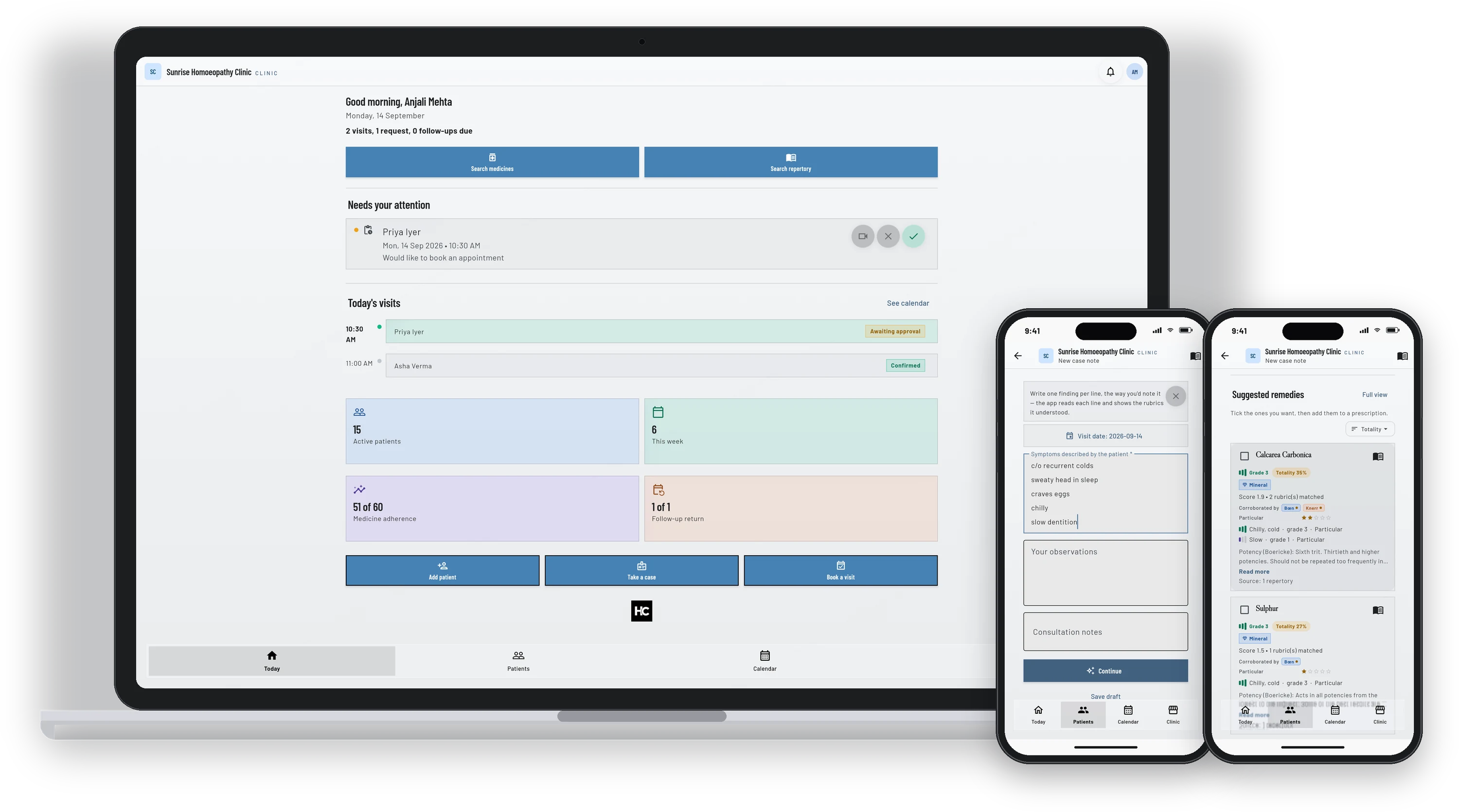
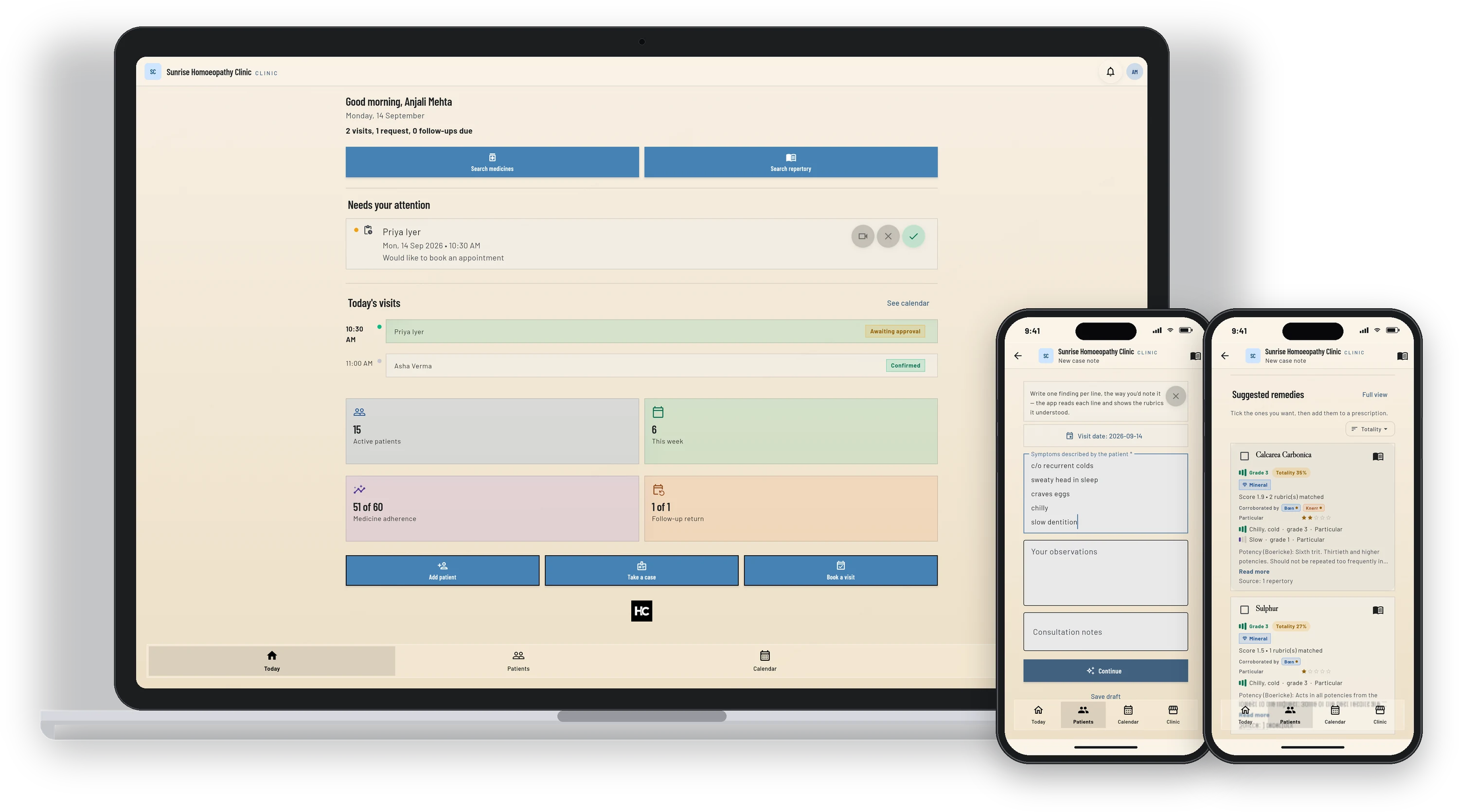
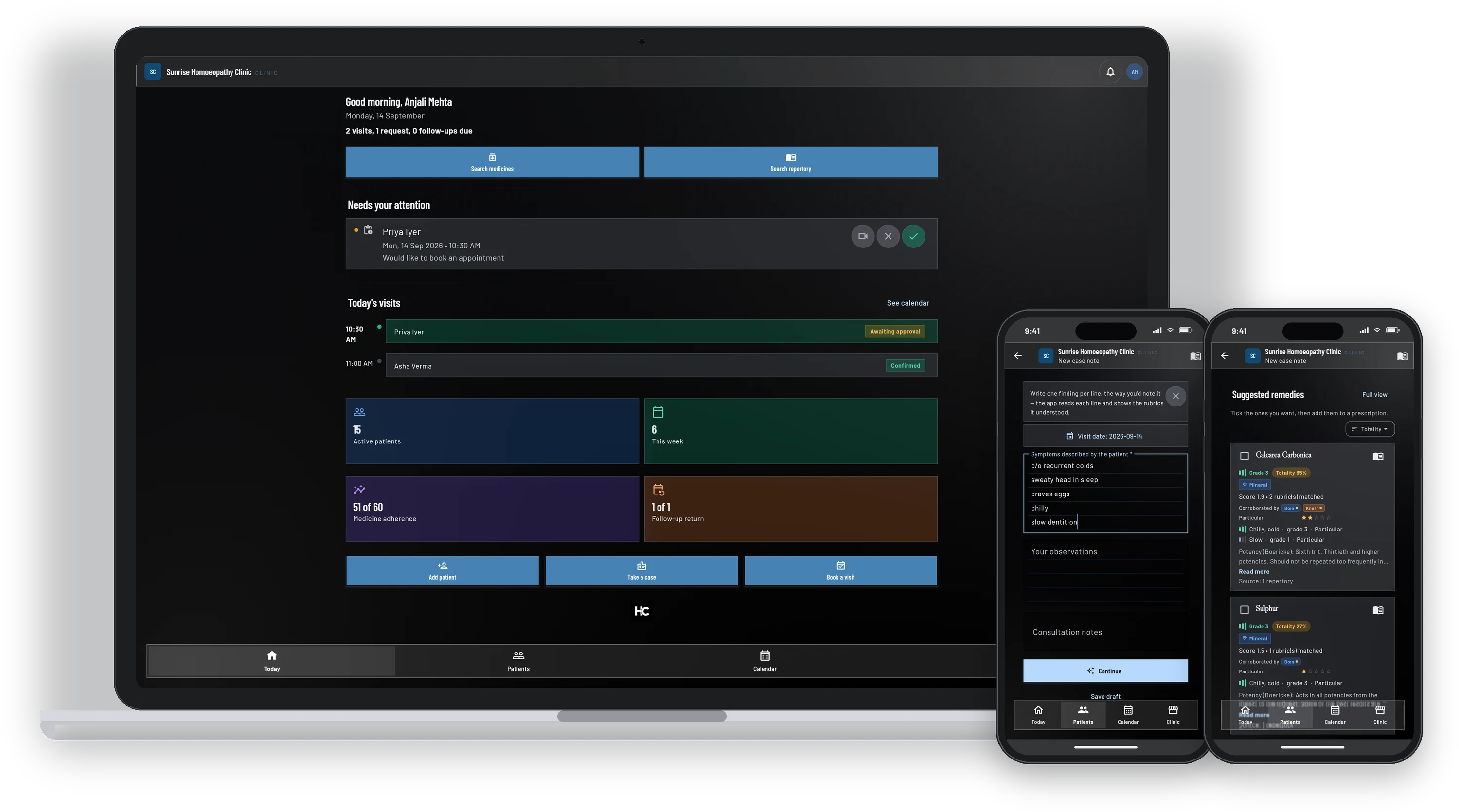
Everything we manage, so you don't have to
01 — FeaturesWrite it your way. We'll read it that way too.
A good case demands two hours, and every minute spent shaping it into a form is a minute stolen from the patient. So drop the form — write the way you already write: c/o, k/c/o, < and >, agg / amel, x 3/12, one finding to a line — and it is read exactly as written. Nothing to fill in, nothing to translate on the way.
Your patient doesn't talk like a 19th-century textbook. We bridge that gap.
The corpus speaks in old, formal English; your patient speaks in the everyday kind. Whatever you write is matched against rubrics across a rich set of classical repertories — and searching, adding, dropping stays entirely in your hands before anything is ranked. What comes back is clinical reference to verify: a list to tick, never a remedy chosen for you.
What did you give last time, and at what potency? Six months on, one tap away.
In most clinics that answer is buried somewhere in a bound register. Here, every prescription stays tied to the case that produced it — remedy, potency, date, and what you wrote that day. The PDF comes out on your own clinic's name and letterhead, ready in seconds, to hand over or send.
A patient searches for you. Someone else shows up instead.
The clinics with a page get found; the rest are just a phone number nobody can see. Pick a colour, hit publish — yours goes live at yourclinic.
Never leave the case to go check a remedy again
Getting up to check one remedy is exactly how a case loses its thread. Remedy pictures from the classical authors, with the relationships between remedies drawn out, open right on the same screen as the case you're taking — without leaving the patient's notes, without leaving your chair.
The clinic is shut Thursday. Tell every patient at once.
Otherwise that news travels one phone call at a time, or arrives once the patient is already standing at a locked door. Post it once and every patient of the clinic sees it — a holiday, a changed hour, anything they need before they set out.
Not every follow-up needs four walls. We'll open the Google Meet ourselves.
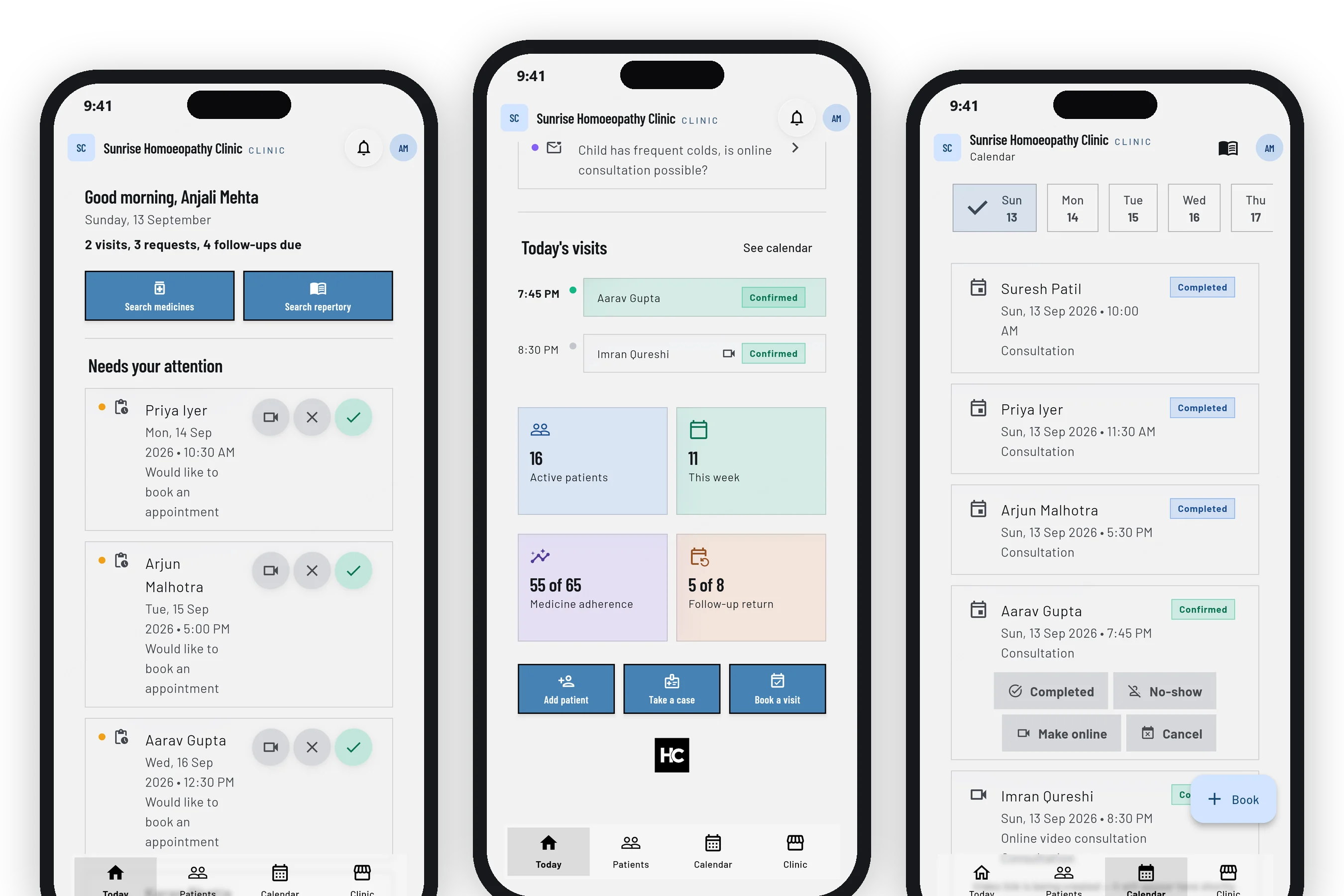
Book the appointment as online, and the moment it's confirmed a Google Meet link is generated and reaches the patient on its own — no separate app to open, no scramble for a link at the last minute. The clinic stays just as ready for the patient who can't walk in today.
Worth a lab test? We'll flag it — before you prescribe.
As the case comes together, relevant investigations surface straight out of what you've already written — never a diagnosis, just a nudge worth weighing, and the call is always yours. Order the tests, write the prescription, and both land in the patient's app the same moment — no printout to lose, no message to send twice.
What you actually prescribe is in no book. Now it's on the same screen.
Fifteen years of work usually lives in one Excel sheet — the combinations, the sequences, the pairings that work on your patients. Upload that sheet; there are no required column headings, the content tells us which column is which. When a case matches a row you wrote, it appears above the ranked remedies, marked as yours. Never blended into our suggestions — your experience and a 19th-century book are two different kinds of evidence.
Every row can name its book and page
No percentage, no confidence score — that claims something nobody measured. Instead: which books carry the rubric, which author gave which remedy which printed grade, and the page. Same note, same list, every time.
Three steps, in the order you already work
02 — How it worksTake the case
Type findings the way you say them, one per line. The note is kept as a draft until you are ready.
Check the rubrics
The rubric list sits above the remedies. Search, add and drop rows in place; the case stays where it is.
Prescribe and follow up
Prescribe and share the document. Dose reminders go to the patient; follow-up reminders come back to the clinic.
Chronic work needs months; the follow-up is what gets lost
The follow-up is the visit that tells you whether the remedy acted, and it is the one most easily lost. Patients get their own app: their prescription, the schedule you set, appointment booking, and a direct line to the clinic through in-app notifications.
Reminders go out on their own schedule, so nobody in the clinic has to remember to send them. What the patient takes, how long for, and when to stop remains your instruction — never the app's.
A remedy's keynotes — free, in your browser
04 — Free extensionMateria Medica Search
A free Chrome extension: type a remedy — nux-v, puls, kali bich — and see the keynotes the classical authors agree on, in their own words, with how many books state each one independently. No account, no sign-up.
Relationships included
Complementary remedies, antidotes and inimical pairings on the same card, cautions first. For every remedy in the corpus, free permanently.
Right where you read
Select a remedy's name on any page — a forum, a PDF, another reference site — right-click, and look it up without leaving what you're reading.
From the clinics
05 — From the clinicsPick the size of your practice
06 — PricingStudying rather than practising? The Scholar plan is ₹149 / month.
Solo
One doctor account, one clinic
- Unlimited patients and case notes
- Repertorisation across a rich set of classical repertories
- Prescriptions and PDFs on your clinic letterhead
- Dose and follow-up reminders, in-app
- In-app announcements to every patient of the clinic
- Appointment booking and the patient app
- Repertories and materia medica downloadable for offline use
- Your clinic’s own website — booking and enquiry form built in, hosting included
50% off your first three months. No card to register — seven days to activate.
Clinic
Up to 4 doctor accounts, one clinic
- Everything in Solo, for up to four practitioners
- ₹500 per month for each doctor beyond four
- The clinic opens on the head doctor's single registration number
- Shared patient register for the whole clinic
- Prescriptions kept separate for each doctor
- Clinic-wide appointment and follow-up queue
- Branded documents across all accounts
- One invoice for the practice
- One clinic website listing every doctor, booking built in
50% off your first three months. No card to register — seven days to activate.
Prices in INR, exclusive of applicable taxes. Quarterly and yearly rates are the monthly price less 12% and 25% respectively, charged in full at the start of the term.
Questions doctors actually ask
07 — FAQWhat does Homoeoclinics include?
Everything around the case: patient records, case notes written in your own shorthand, repertorisation across a rich set of classical repertories, prescriptions with PDFs on your clinic's letterhead, dose and follow-up reminders, appointment booking, announcements to every patient of the clinic, a patient app, and your clinic's own website with hosting included. One subscription — there are no modules to add on.
Which repertories does it search?
A rich set of classical works, searched as one corpus: Kent's Repertory, Knerr's Repertory of Hering's Guiding Symptoms, Gentry's Concordance, the Boger–Boenninghausen Characteristics and Repertory, Boenninghausen's Therapeutic Pocket Book, Boericke's Repertory, Boger's General Analysis, and Clarke's Clinical Repertory — the last indexed by diagnosis rather than symptom, so it answers a different question from the rest. Search also includes a ninth book of our own, which helps when the same symptom is worded differently across books.
Does it choose the remedy for me?
No. Homoeoclinics is not a diagnostic product. It stores and displays prescriptions entered by a qualified practitioner; it does not diagnose or recommend remedies. What repertorisation returns is clinical reference — a list of rubrics and remedies for you to verify before prescribing, never a decision made for you.
What does it cost?
Solo is ₹999 a month, Clinic is ₹2,499 a month for up to four doctor accounts, and the Scholar plan is ₹149 a month. Quarterly billing saves 12% and yearly saves 25%. Doctor plans start at 50% off for the first three months, with no card needed to register and seven days to activate. Scholars are billed from the day they subscribe. Prices exclude applicable taxes.
Does it work offline?
Yes. Repertories and materia medica can be downloaded to the device and read without a connection. Case notes and prescriptions written offline are kept safely on the device and sync on their own when the network returns — a clinic with unreliable internet does not stop working.
Is my patients' data private?
Case notes are read by our own software on our own servers — they are never sent to a third-party AI service or anywhere outside the application's infrastructure. Every record is scoped to your clinic, and only your clinic's accounts can reach it.
How does my clinic's website work?
Pick a colour and press publish — your clinic is live at yourclinic.homoeoclinics.com with your timings, appointment booking and an enquiry form. There is no domain to buy, no hosting to renew and nothing to maintain; it is included in every plan.
What is the difference between a doctor and a scholar account?
A scholar reads the same materia medica, repertories and philosophy corpus a practising doctor does, but has no clinic, no patients and no prescriptions, and reaches nothing clinical. The subscription is personal and priced separately. When a scholar qualifies, they can apply from inside the app to be promoted to a doctor account.
Do you use AI to pick the remedy?
No, and that is a design decision rather than a gap. Our suggestion path calls no external model and no third-party service, so the same case note returns the same list every time and every row can name the book, author, printed grade and page behind it. In a 2026 study of four AI chatbots on 100 acute cases, the same platform asked the same question minutes apart returned a different top remedy in half of the repeat tests. A reference that changes its mind is not a reference.
Can I use my own combinations?
Yes. Upload the spreadsheet you already keep — there are no required column headings, because the importer works out which column is which from the content of the cells. When a case matches a row you wrote, that row appears above the ranked remedies, marked as yours. It is private to you unless you choose to share it with your clinic, it is stored encrypted at rest, and it cannot move our ranking.
Can I see which book a suggestion came from?
Yes — that is the point of the rubric list. Every row shows which books carry the rubric, which author gave which remedy which printed grade, and the page. You can search and add a rubric the reader missed, or mark one “not this”, before anything is ranked. The classical texts the corpus is built from are published on our own site, including the ten we examined and declined.